
The book: SURVIVOR
Junyo Maru & Pakan Baroe
Willem Punt & Nicola Meinders
“Survivor, is the story of my life at sea and how I survived World War II.”

The Hellship Junyo Maru
The Hellship Junyo Manu
There are also many WW2 historians, who have had spent their lives researching the second world war, and the sea battles. However, there are fewer that know the stories firsthand from the battles surrounding the former Dutch East Indies. This book records numerous examples of Hellships, but factually recalls the experience of being on a Hellship firsthand. The fact that this is a story of the Junyo Maru, the largest loss of life on a Hellship and the infamous tragic occurrences, make this story relevant for WW2 historians and naval researchers too.
Extract from the book
“We were led to a quay where the Junyo Maru was anchored. It was a rusty old wreck. At that time, it was considered a huge freighter, I guess around 6,000 register tonnes. We could see the people at the front already boarding the vessel via a wide wooden staircase that was placed against the ship. On board they were literally kicked into the holds, to chase them to the depths of the hull. We discovered that the rear half of the ship was reserved for us.
The front of the ship was loaded with indigenous people, who had been recruited or captured by the Japanese to work for them. The Japanese visited villages and paid the village chief for the men to be used as labourers. If the chiefs refused, the men were taken anyway, and the chiefs weren’t paid. Later, the Japanese also started taking their boys saying they would be given a Japanese education. These people were the cheapest of their labourers and seen as most expendable. They were slave labourers, or romushas. They were all kept far away from us whites and were treated much more harshly than us. The Japanese ensured we made no contact with them.
There were approximately 4,000 Indonesians located in the front section of the ship. In the rear part there were around 2,300 allied POWs (mainly Dutch). […] There were only two lifeboats midship, which could carry 60 to 70 people. These were meant for the Japanese, not us, as there were far too many of us.
The holds were normally divided by two metal platforms, creating horizontal spaces: the top, middle and bottom hold. The bottom hold was sealed as there was probably cargo in it. The mid and top areas were for people.
Each of these two holds were further split into three horizontal layers, constructed from wooden buttresses with shelves. These spaces were only 70cm high. Thus, the Japanese managed to squeeze in six layers of people above their cargo. Each man had to crouch, almost crawling, to get in”.
Order this unique book
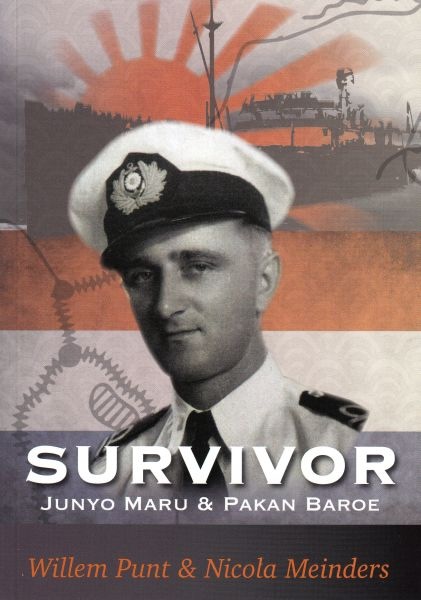
SURVIVOR - WILLEM PUNT & NICOLA MEINDERS - SOLD OUT!
Dutch language edition. Soon available as e-book (e-pub version). 176 pages.
SURVIVOR - WILLEM PUNT & NICOLA MEINDERS
English language KINDLE e-book edition. 176 pages. 9,99. BUY NOW
SURVIVOR - WILLEM PUNT & NICOLA MEINDERS
Paperback on stock. English language edition. 176 pages. 15,-. BUY NOW